Opening Soon
Repetitive transcranial magnetic stimulation, or rTMS, is a noninvasive treatment that uses repeated magnetic pulses delivered through a coil placed near the scalp to treat mental health conditions. At The Mind Grove TMS Center in Colorado Springs, rTMS is provided within a physician-led psychiatric care model by Megan Bowers, MD, PhD.
Dr. Bowers evaluates whether conventional rTMS, iTBS, Accelerated TMS, augmentation with management, or a combination of care is clinically appropriate. Treatment recommendations are based on diagnosis, treatment history, safety considerations, and the patient’s current care plan.

rTMS is a form of transcranial magnetic stimulation. During treatment, magnetic pulses are delivered in repeated patterns to targeted cortical regions involved in mood regulation. Put more simply, rTMS is designed to stimulate brain areas that are part of larger mood-related networks.
Evidence-based guidelines have identified depression as one of the psychiatric conditions with the strongest evidence base for therapeutic rTMS. rTMS is not always a cure and is not appropriate for every patient, but it may be considered when prior treatment has not provided adequate relief. Medication can remain part of care when it supports the treatment plan.
A conventional rTMS course at The Mind Grove TMS Center is delivered as a structured series of appointments.
In a 2023 meta-analysis of randomized, sham-controlled trials, rTMS was associated with better response and remission outcomes than sham treatment for patients with major depressive disorder who had already tried two antidepressant treatments without adequate relief.
This evidence does not mean that rTMS works for every patient. It supports rTMS as an evidence-based treatment option that should be considered in the context of diagnosis, prior treatment response, safety factors, and clinical judgment.
rTMS is a broader treatment category that includes different stimulation patterns. Conventional rTMS and iTBS are related, but they are not identical.
iTBS is a form of rTMS that uses rapid theta-burst stimulation patterns. Each iTBS appointment is approximately 20 minutes, with about 3 -10 minutes of stimulation per treatment session. Accelerated TMS uses iTBS or standard rTMS as its delivery method and follows a separate treatment schedule.
The THREE-D trial compared intermittent theta-burst stimulation with standard high-frequency rTMS for depression and found iTBS to be non-inferior in that study. What this means is that, for adults seeking rTMS for depression, iTBS is a treatment option that can be completed in a shorter amount of time without sacrificing efficacy.
At The Mind Grove TMS Center, rTMS may be considered for qualifying depression-related conditions, including:
For adolescents with MDD, Dr. Bowers evaluates candidacy carefully based on age, diagnosis, clinical history, and safety considerations. A 2023 systematic review and preliminary meta-analysis found that rTMS may benefit children and adolescents with MDD, while also noting more clinical studies are needed to clarify the effectiveness of iTBS in adolescents. TMS with the MagVenture device is FDA-cleared as an adjunctive treatment for adolescents 15 or older with MDD.
The Mind Grove TMS Center may also consider rTMS, iTBS, or Accelerated TMS for generalized anxiety disorder or PTSD when clinically appropriate. TMS is now FDA cleared for the treatment of PTSD, when combined with quantitative EEG and the MagVenture device only, using the MeRT protocol. The use of TMS for GAD, or for PTSD without quantitative EEG is off-label, meaning they are not FDA-cleared for those primary indications, and are generally not covered by insurance.
Research on rTMS for generalized anxiety disorder and PTSD is still more limited than the evidence base for depression-related conditions, however several studies have demonstrated symptomatic improvement for both conditions after completing TMS. Because these uses are off-label and generally not insurance-covered, Dr. Bowers evaluates them on a case-by-case basis, considering diagnosis, symptom pattern, treatment history, and overall clinical appropriateness.

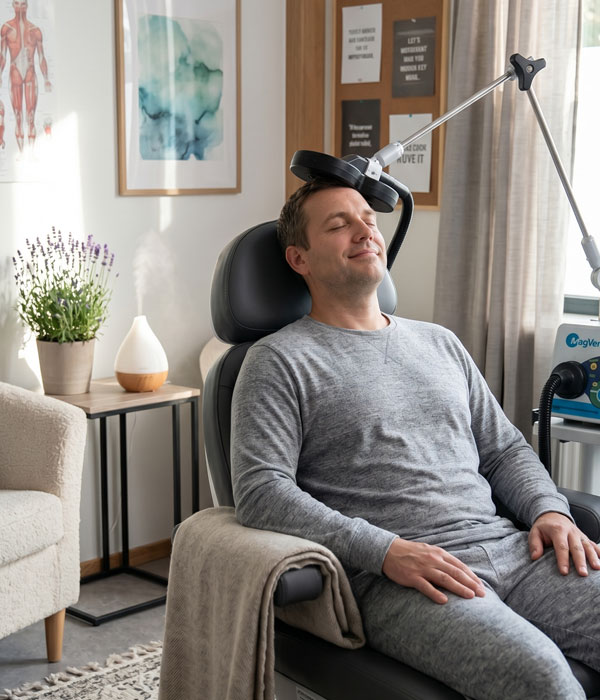
Before rTMS begins, Dr. Bowers evaluates whether treatment is appropriate for the patient’s diagnosis, clinical history, and safety profile. If rTMS is appropriate, treatment takes place in the Colorado Springs office.
During a conventional rTMS session:
Some patients may notice tapping sensations during treatment. Possible side effects can include discomfort where the magnet is placed, tingling in the scalp or face, mild headache, brief lightheadedness, or dizziness. Safety guidelines for TMS emphasize appropriate screening, training, and monitoring. Dr. Bowers reviews safety considerations before treatment begins.
The Mind Grove TMS Center is led by Megan Bowers, MD, PhD, a dual ABPN board-certified psychiatrist in Adult Psychiatry and Child and Adolescent Psychiatry.
Dr. Bowers’ training spans developmental genetics, neurobiology, and clinical psychiatry. She completed medical and graduate training at NYU School of Medicine, a postdoctoral research fellowship in Neurobiology at the University of Zurich, Adult Psychiatry residency at Georgetown University Hospital, and Child and Adolescent Psychiatry fellowship at Georgetown University Hospital.
That background matters because rTMS is not treated as a generic protocol. Dr. Bowers evaluates each patient clinically, monitors progress during treatment, and incorporates medication management when it supports the care plan.
The Mind Grove uses MagVenture technology for TMS treatment.

The Mind Grove TMS Center provides rTMS therapy in Colorado Springs for patients who need physician-led evaluation for depression-related conditions and, when appropriate, carefully selected off-label uses.
The practice offers conventional rTMS, iTBS, Accelerated TMS, and medication management when clinically appropriate. Each treatment recommendation is made after a comprehensive clinical evaluation.

Insurance is accepted for qualifying FDA-cleared indications. Coverage varies by payer, diagnosis, and medical-necessity criteria.
Select accelerated protocols are FDA-cleared with the MagVenture device, but are not currently covered by insurance.
TMS for PTSD using the MeRT protocol is now FDA approved, however is not covered by insurance.
TMS for generalized anxiety disorder is off-label and generally not covered by insurance. Colorado Medicaid does not cover TMS.
A conventional rTMS course typically includes 36 to 40 sessions. Treatment is delivered daily over four to six weeks, followed by a taper phase. The full course typically spans eight to ten weeks.
rTMS is most commonly considered for depression-related conditions, including major depressive disorder, treatment-resistant depression, and MDD with co-occurring anxiety symptoms for adults, and MDD for adolescents ages 15-21. Dr. Bowers may also consider TMS for generalized anxiety disorder or PTSD when clinically appropriate.
Yes. iTBS is a form of rTMS that uses rapid theta-burst stimulation patterns.
Schedule a consultation with The Mind Grove TMS Center in Colorado Springs to discuss whether rTMS may be appropriate for your condition, treatment history, and current care plan.
Blumberger, D. M., Vila-Rodriguez, F., Thorpe, K. E., Feffer, K., Noda, Y., Giacobbe, P., Knyahnytska, Y., Kennedy, S. H., Lam, R. W., Daskalakis, Z. J., Downar, J., & others. (2018). Effectiveness of theta burst versus high-frequency repetitive transcranial magnetic stimulation in patients with depression (THREE-D): A randomised non-inferiority trial. The Lancet, 391(10131), 1683–1692.
Brown, R., Gassama, S., Wickham, R. E., Sahlem, G. L., & others. (2024). Repetitive transcranial magnetic stimulation for post-traumatic stress disorder in adults. Cochrane Database of Systematic Reviews.
Lefaucheur, J.-P., Aleman, A., Baeken, C., Benninger, D. H., Brunelin, J., Di Lazzaro, V., Filipović, S. R., Grefkes, C., Hasan, A., Hummel, F. C., Jaaskelainen, S. K., Langguth, B., Leocani, L., Londero, A., Nardone, R., Nguyen, J.-P., Nyffeler, T., Oliveira-Maia, A. J., Oliviero, A., … Ziemann, U. (2020). Evidence-based guidelines on the therapeutic use of repetitive transcranial magnetic stimulation (rTMS): An update (2014–2018). Clinical Neurophysiology, 131(2), 474–528.
McClintock, S. M., Reti, I. M., Carpenter, L. L., McDonald, W. M., Dubin, M., Taylor, S. F., Cook, I. A., O’Reardon, J., Husain, M. M., Wall, C., Krystal, A. D., Sampson, S. M., Morales, O., Nelson, B. G., Latoussakis, V., George, M. S., & Lisanby, S. H. (2018). Consensus recommendations for the clinical application of repetitive transcranial magnetic stimulation (rTMS) in the treatment of depression. The Journal of Clinical Psychiatry, 79(1), 16cs10905.
Parikh, T. K., Strawn, J. R., Walkup, J. T., & Croarkin, P. E. (2022). Repetitive transcranial magnetic stimulation for generalized anxiety disorder: A systematic literature review and meta-analysis. International Journal of Neuropsychopharmacology, 25(2), 144–146.
Qiu, H., Cui, L., Lu, R., & others. (2023). Efficacy and safety of repetitive transcranial magnetic stimulation in children and adolescents with depression: A systematic review and preliminary meta-analysis. Journal of Affective Disorders, 320, 305–312.
Rossi, S., Antal, A., Bestmann, S., Bikson, M., Brewer, C., Brockmöller, J., Carpenter, L. L., Cincotta, M., Chen, R., Daskalakis, J. D., Di Lazzaro, V., Fox, M. D., George, M. S., Gilbert, D., Kimiskidis, V. K., Koch, G., Ilmoniemi, R. J., Lefaucheur, J.-P., Leocani, L., … Hallett, M. (2021). Safety and recommendations for TMS use in healthy subjects and patient populations, with updates on training, ethical and regulatory issues: Expert guidelines. Clinical Neurophysiology, 132(1), 269–306.
Vida, R. G., Sághy, E., Bella, R., Kovács, S., & others. (2023). Efficacy of repetitive transcranial magnetic stimulation (rTMS) adjunctive therapy for major depressive disorder (MDD) after two antidepressant treatment failures: Meta-analysis of randomized sham-controlled trials. BMC Psychiatry, 23, 545.